

Prologue: Self-portrait with America
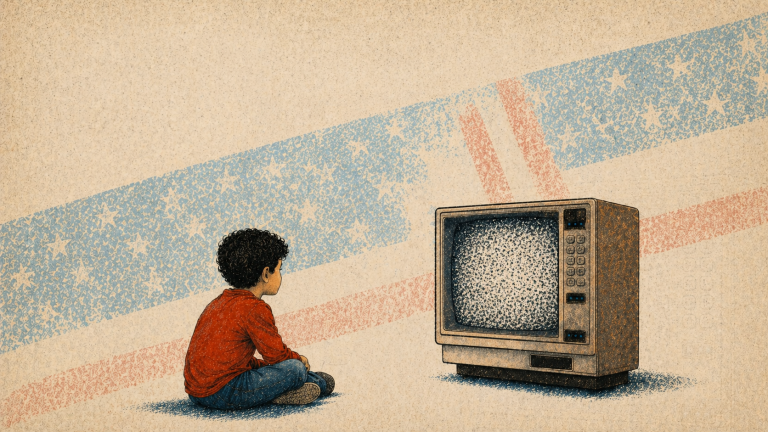
Before it was a country, America was first a light for Walid. Projected into his child’s eyes by a white-edged cathode-ray television set, in the Val-de-Marne.
It was not yet a dream. But it was already a refuge: the world of TV shows, cartoons, ordinary heroes who, one day, are given the chance to reveal who they truly are. Then, one evening in January 1991, the programme is interrupted. Baghdad appears on screen, war enters the family living room, and history stops having only one version.
Later would come hip-hop, the aftermath of 9/11, the first trip to New York, Obama, Trump. And one question that never went away: what remains of that childhood light Walid once took for America?
You can also listen to this episode on Spotify, Apple Podcasts and your favorite podcast platform.
Episode #1 – Black America
Michael Jackson, Michael Jordan, Michael Johnson. Then Martin Luther King, Malcolm X, hip-hop, and Boyz n the Hood. As a teenager in the 1990s, the America that spoke most deeply to Walid was embodied by its Black icons. Voices, bodies, a way of carrying oneself, an energy, but above all a way of inhabiting the world: turning style into language, anger into power, memory into counter-narrative, and struggle into a global imaginary.
In Atlanta, with the writer, curator and historian TK Smith, and the visual artist and scholar Fahamu Pècou, one question comes into focus: what does it mean to carry a culture celebrated everywhere, when real equality remains contested at home?
From the Great Migration to Atlanta’s rise as a Black Mecca, from Obama years to Trump’s return, Black America explores the paradox of a Black culture at the heart of the American Dream’s imagination — yet still kept at a distance from its promise.
You can also listen to this episode on Spotify, Apple Podcasts and your favorite podcast platform.
Episode #2 – License to Belong
At school in the Paris suburbs, Walid was taught that America is a melting pot: a country where coming from somewhere else was not a problem, but part of the story – even something you could be proud of.
Born there, raised there, American. Period.
For years, one idea seemed to make that promise real: birthright citizenship.
But belonging is something else. It is the moment your voice counts — when you too get to help define the “we.”
In Atlanta, Walid sits down with Gyun Hur, a Korean American artist and educator, and Amenah Arman, a Palestinian American trauma therapist. Both grew up with mixed messages about what their families’ choice of America was supposed to mean.
Both are professionals navigating a political climate that shapes their work — and sometimes pushes against it.
Both are also mothers, now facing the same question: What do you pass on, when belonging feels like permission granted by others?
You can also listen to this episode on Spotify, Apple Podcast and your favorite podcast platform.
Episode #3 – Nuevo South
Give me your tired, your poor, your huddled masses yearning to breathe free. The words are carved in copper at the foot of the Statue of Liberty.
Today, that promise looks like a dead letter. ICE raids at dawn, separated families, the National Guard in the streets. The criminalization of migrants is no longer exceptional. It’s an assumed policy.
Latinos — the largest minority in the country, an economic force decisive in swing states — live between exploitation, the permanent threat of deportation, and the need to be seen.
In Atlanta, Walid meets with two women map that reality from the inside.
Gigi Pedraza left Peru, lived in Chicago and Boston, before settling in Atlanta — a city emblematic of the civil rights movement, proud of its “Atlanta way” of getting along. She founded the Latino Community Fund Georgia when she realized her community was everywhere in the state — and invisible in its official story.
Jennifer — a pseudonym she chose — crossed the border from Mexico as a child, without legal status. She learned early to navigate a system designed to keep her on the margins — until Freedom University helped find her way through.
Together, they give voice to a reality that remains largely undocumented — like so many of the people who live it.
You can also listen to this episode on Spotify, Apple Podcast and your favorite podcast platform.
Episode #4 – Betting on US
In American teen movies, one college acceptance letter can change everything. For decades, that scene carried a country’s promise: education as the way out, and up.
Today, the promise feels worn thin. Student debt. Diversity programs dismantled. A degree that no longer guarantees a decent job, let alone a better life than your parents’.
And yet education is never only about credentials. It is also about what a country chooses to pass on, or fails to.
To explore this tension, Walid turned to two people who live it from both sides — personal and professional.
In Atlanta, in spring 2025, at the end of his stay, he sits down with Elizabeth Elango, then head of the Global Village Project, a school for refugee girls. Born in Cameroon, shaped by two continents, she welcomes students arriving with stories of war and displacement, and tries to make room for joy and wonder in the school day.
In New York, he meets Amir Moosavi, then assistant professor at Rutgers Newark. Son of an Iranian father and an American mother, he grew up in Milwaukee when the Gulf War, and later 9/11, made names like his harder to carry. He was teaching at a time when the country’s divisions were already showing on campus.
Walid closes the series with a personal note one year after these conversations.
You can also listen to this episode on Spotify, Apple Podcast and your favorite podcast platform.
Help us tell the world to you !
Frictions is launching its club : by supporting Frictions, you’ll be supporting a community of authors and journalists who tell the world through intimate stories!

What’s Left of the American Dream? is a bilingual documentary mini-series written and produced by Walid Hajar Rachedi, with editorial and production support from Ryad Maouche and Laura Taouchanov. The series was produced during a Villa Albertine residency in Atlanta, in spring 2025. Many thanks to the Villa Albertine team for their welcome and support.