




Translated from French by Adam Cutforth.
Villa Kennedy
Izadora doesn’t remember how old she was when she first saw the sea. About six or seven years old. One southern summer day in the mid-90s.
Read more
But she hasn’t forgotten that intense, infinite dazzle. Drinking in the endless sunshine with her eyes or her lips. She can’t remember which. She thought she knew that Carioca sun already… She only knew its vengeful side. Its western side. The one that pounds asphalt and heads, biting without remorse from November to February, suffocating you on those lengthy bus trips on the Avenida Brasil… Its more clement, southern side, she discovered that day: the sun keeps it for those supple, golden bodies, triumphant with life, stretched out on those white strips, Copacabana, Ipanema… where Izadora treads shyly with her caramel-coloured feet.
“Is that sugar?”
In response, her father bursts into a powerful laughter, almost as intense and infinite as the sun that she can’t stop drinking. “Of course not, it’s sand, minha princesa pretinha (‘my little Black princess’). The most beautiful sand in the world, that of our wonderful city of Rio de Janeiro.” His Brahma beer out of the cooler, he is now the happiest man in the world. He almost allows himself some nostalgia: “When I was your age, I used to live nearby, you know… With my friends, we used to go down the morro (‘hill’) on Sundays to take a dip. But then, we all had to move away. After the fire.”
Her mother is too busy setting up what appears to be a camp, to show any amazement. For until such time as she had defined their space in this territory and her daughters were ready, “just so”, — hair, bathing suit, sound of their voice… not showing too much, nothing too obvious — the mother will feel uncomfortable, under siege. She will keep hearing the buzzing remarks you can read in a look, in a forced smile. Like those of the housewives in the South Zone who always find something negative to say about how Izadora’s mother carries out her empregada (“domestic worker”) duties.
Izadora’s sister, Fabiana — with the false self-confidence of a brash teenager from Villa Kennedy — dominates the beach with a single glance, looks up and down those for whom being here is a given, restrains her mother in her zeal for conformity, and tempers her father’s enthusiasm with a Brazilian pop tune that flirts with the funk of the favela:
Rio 40 graus / Cidade maravilha / Purgatório da beleza / E do caos
(Rio 40 degrees / Wonderful city / Purgatory of beauty / And of chaos)
Yes, on this day Izadora wants to drink up all the sunshine. And all the sea as well. Her parents are scared to death. Escaping their surveillance for a moment, chaos will prevail over beauty. Fabiana dives in without a second’s hesitation, fishing her from the bottom of the water. Makes her spit out all the salt from the sea and of her innocence. No one will take her sister away from her.
***
April 2009. It’s been a long time since Izadora left her childhood behind.
She has just turned 21.
But even today, she would still like to drink all the sunshine from the southern slope.
Last day of vestibular, last admission tests for this famous university in the South Zone, it’s now or never… This time, it has to work.
Foco. Força. Fé. Focus. Strength. Faith.
She’s been preparing for this for three years.
She attended Professor Costa’s community pre-vestibular (public prep school), racked up sleepless nights to study and poorly paid jobs to put money aside, filled out all the possible scholarship applications, sent all the supporting documents… — it’s crazy how many papers you have to provide in order to prove what is ordinarily flung straight in your face… What about parties? She gave up on countless parties, opportunities to have fun, boys with such pretty mouths, not to mention the rest…
But here she is, back at square one: stuck on the western side.
Yesterday, Rio wept all the tears of its body. Houses collapsed on the hills of the Western and Northern Zones.
Some have lost everything. Their belongings, their lives.
Izadora didn’t get a wink of sleep, on the tin roof, the sound of the rain crashing was almost as frightening as the echo of a shooting. One of those where teenage soldiers — as thin as the soles of their Havaianas — fight over the domination of a territory, a trade, a means of survival…
At daybreak, the walls are still standing.
From her window, the unreal spectacle of a boat. Firemen are crammed into it. It criss-crosses through the streets of the Villa Kennedy favela. Rua Zâmbia (Zambia), Rua Sudão (Sudan), Rua Congo, Rua Camarões (Cameroon)… Africa is no longer a mere fiction, a place attached only to the names of streets, since it has invaded the neighbourhood as small red and muddy rivers.
And a less than desirable Africa at that.
A mental association drawn from the reports we watch during commercial breaks, when Domingão do Faustão and other deliciously mind-numbing programmes are on, made her mother comment somewhat naively: “We’re not doing so badly here, after all… God bless Brazil,” and Fabiana, to reply in a dry voice: “In front of their TV, over there, they may be saying the same thing about us…”
Small red rivers that give substance to the other part of her anguish: bus traffic is very disturbed in the Western Zone. Monster traffic jams where cars circulate.
Izadora feels her breath shortening, a line of pain running from her forehead to the back of her head.
Dying. For a moment, she wants to die. Just for a moment. Die so she doesn’t have to think.
Foco.
Força.
Fé.
Foco.
Força.
Fé.
Foco.
Força.
Fé.
Foco.
Força.
Fé.
She repeats compulsively to herself so as to contain the panic.
On the living room wall, a picture of her deceased father tries to reassure her. In the bedroom, her mother whispers blessings. Jesus can do anything, she believes. On the screen of her mobile phone, Fabiana didn’t wait for him. As she did in days past, she is working out a plan to keep her head above water: “Meeting place at Praça (‘square’) Miami, in front of the statue.”
But how can you go down the street without getting your legs wet? She barely has enough time to ask herself this question when someone knocks on the door. It’s the neighbour: “Fabiana told me you’d need this…” Her husband is a gari (“street sweeper”) She hands her a pair of plastic boots, the ones he keeps in reserve. Izadora thanks her profusely. The neighbour gently rebukes her: “It’s God who gives.”
She puts them on like stilts, managing to walk down the street without falling down.
Below, a shrill male voice calls out:
“Patricinha (‘Marilyn’) Kennedy… What a walk, a real parade! Where are you going like that, to college or to fashion week?”
“Edilson, what are you doing here?”
The young man, wearing a red and black football jersey — Flamengo, naturally — a smile as wide as his shoulders, retorts:
“What do you think? It’s your hard-headed sister. She couldn’t make it… She requisitioned me… And my uncle’s van too! It’s like she’s never heard ‘no’ in her life!”
Edilson’s good mood is catchy. Izadora feels her headache clearing up. They head towards the vehicle. At the centre of the square behind which Edilson is parked, stands, on a concrete mound, surrounded by wire mesh, the Statue of Liberty, a replica of her cousin in New York. An enclosure within an enclosure. Her dress covered with graffiti, she looks even sadder on this rainy day. Izadora stops for a moment. Edilson, banging loudly on the fence to snap her out of her reverie remarks, mocking: “They put the bars even higher, they were so afraid she’d run away too!”
Izadora can only smile in reply.
She thinks back to that day three years ago, when she walked around the neighbourhood with Professor Costa and the other students of the pre-vestibular as if she was discovering it for the first time.
The doctoral student in History who had initiated the Program to help young people in the community gain access to university, long before the policies institutionalized by the Lula Government, made it a point of honour to tell the history of the neighbourhood. Legend has it that the thirty-year-old man, son of servants who had emigrated from the Nordeste, had taught himself to read. Like a sort of Christopher Columbus who would have discovered a new continent of knowledge using the oars of his efforts alone. It was Fabiana who had told him this as one would tell a tale. The Professor was the only person her sister had ever spoken of with such devotion. A nurturing figure who had inspired Fabiana’s vocation as a teacher and her various commitments in the community. Not even Jesus was accorded such favours. Her mother was wary of him. “He believes in nothing but himself,” she said. She would have prefered that Fabiana’s work be overseen by Pastor Eraldo’s parish. But then again…she couldn’t deny the effectiveness of his methods: Fabiana was the first person in the family to graduate from university. God would understand.
In front of the Statue of Liberty, the Professor asked the students if they knew why their neighbourhood was called “Villa Kennedy”. Silence in the audience. “Every place has a story, not knowing where you come from is giving up half of who you are.” His talk was full of those types of maxims. Izadora wondered if the Professor had made them up or if he had taken them out of a book… So she learned that their neighbourhood was named after the then President of the United States, John Fitzgerald Kennedy, who died two months before its inauguration. He was murdered in his car, commented one of the students who had apparently heard of him in a film about a beautiful blonde, a starlet… In the context of the Cold War, after the Cuban revolution, its “Alliance for Progress” program was launched to finance various projects in Latin America with the aim of “slowing the advance of communism”.
Izadora couldn’t tell from the Professor’s tone whether he considered it a good or bad thing… What is certain is that the governor of the state, Carlos Lacerda, thought the operation to be a great success: 5,509 homes with drinking water, electricity and a sewage system, streets, a square… A real luxury for the former inhabitants of the favelas of the South Zone, he believed. In any disgruntled people who argued that the inhabitants had been forcibly evicted and that the two and a half hours of transport from the city centre would make their daily lives difficult the governor responded: “This is only the beginning… Tomorrow, even the people of Leblon and Ipanema will want to live here! Soon, I promise, there will be a centre for crafts and community services, farms, a textile factory, a bakery, schools, a nursery, sports fields, a cinema… and even a swimming pool!”
By the way he had spoken, you’d have thought that Carnival had come early, on this day of January 20, 1964.
In the surrounding euphoria, in order for the tribute to be complete, the governor had thought of commissioning a bust of the American President Abraham Lincoln and having the sculpture placed in the central square, to be named Praça Miami. But he’d come up with something even better: in the garden of the Paranhos family, wealthy landowners of the South Zone, stood a miniature replica of the Statue of Liberty made by the French sculptor Frédéric Auguste Bartholdi — a commission from the Paranhos to commemorate the tenth anniversary of the proclamation of the Republic of Brazil.
When the American technicians came back two years later, in 1966, they found that none of the promised work had been carried out… and that even though the statue still presided over the Praça Miami, the ideal of democracy and freedom it symbolized no longer had its rightful place: the military had overthrown the Republic… “slowing the advance of communism”. This time, Izadora had little doubt over Professor Costa’s opinion.
The dictatorship lasted until 1985. The Republic returned. But overall, nothing had really changed: there in the middle of Avenida Brasil, riding in the van, her ears full of Edilson’s Puta Que Pariu (“For Fuck’s Sake”) — swear words directed at the standstill traffic, and railing against fate more than anything — her hands clenched in her lap, the sea had never seemed so distant to Izadora.
Nor has the possibility of another future.
Run, Iza, Run
Forty-eight minutes. That’s how much time is left for Izadora to get to the examination room.
Read more
The Avenida Brasil is followed by the expressway, Linha Vermelha, which runs along the sea to reach the southern side of the city, but the traffic remains slow on the soggy asphalt. Edilson may honk his horn, but to no avail. He turns on the radio as if looking for a diversion. Jorge Ben Jor drags his hoarse voice over a sad samba tune:
Chove Chuva / Chove Sem Parar
(It rains rain / It rains without stopping )
Such a downer.
Although it has stopped raining, the sky is still full of those clouds that Rio de Janeiro never knows what to do with. Rio is a city made for sunshine just as some people are only made for joy. Outside of these conditions, they wander around, lost. The city has a thousand distractions, only the sun gives it a raison d’être.
To their left, on the other side of the strip of water, on Governor’s Island, lies Rio’s international airport, Galeão. Izadora watches the planes, insolent with ease, taking off.
“Forget it, we’ll never make it,” she whispers.
“What’s that? Of course we’re going to make it! Maybe a little late, but we’re going to make it.”
“If you arrive more than fifteen minutes after the exam has started, they don’t let you in.”
“So what, you’d drop out of it, just like that… Three years you’ve been preparing for this test, and now you’re finally here, qualified for the second phase… And at the best university…”
“And with a full scholarship…”
“And you want to give up… I should take you to the mental hospital instead, minha filha (‘my daughter’)!”
“No, I’m not giving up… I’m just tired of all the pressure. Tired of it all the time.”
“Don’t wanna hear it… Be tired tomorrow! Today, you’re gonna go to that damn test and pass it!”
Izadora runs her hands through her hair, takes a deep breath. Edilson goes on:
“What you do, you do for you. First for you. But you’re also doing it for us. For all of us. You know that, right? You know that’s important, don’t you?”
“I know it’s important. I even know it a little too well. Fabiana keeps telling me: we’re leading the way.”
“Go, then! Lead the way!” Foco. Força. Fé.
Edilson’s eyes spit fire. The vehicle would split the flow of cars in half like Moses parting the waters, if it up to his will alone.
Foco.
Força.
Fé.
Izadora repeats this mantra to herself. Her heart shrinks at the thought of disappointing those who have placed so much hope in her. She feels her cell phone vibrating in her bag. She lets it ring in the void, unable to answer the calls of her mother, her sister. She finally relents with a text message: “I’m on my way,” without being sure which “way” she’s referring to.
Fabiana, Edilson, her Mother. Her own personal trinity.
Near the Maracanã stadium, Edilson gets off the main road and rushes through the hilly streets of the Sao Cristavão neighbourhood. He slows down, scanning the building façades, as if looking for something. Izadora doesn’t dare ask him what. Perhaps he finally admitted that their expedition was doomed to fail?
Without warning, he gets out of the vehicle and hails a boy standing on his motorbike in front of an Internet café. Hands him some money. Shortly afterwards, he makes big signs towards Izadora. Who doesn’t understand. Edilson comes halfway back to the vehicle, a motorcycle helmet in his hand. “Well, are you coming?” He shouts at her.
And there they are, on the motorbike, thrown into the Andre Rebouças tunnel, zigzagging between the cars, taking all the risks. Like in a video game. The honking and cursing of upset car drivers doesn’t slow Edilson down. On the contrary, it speeds him up. He exults in the manner of a supporter who’s team is behind on the scoreboard: “At Villa Kennedy, we don’t give up!” Izadora thinks he’s going to receive a real dressing-down from his uncle when he finds out where he has left his van. And her mother… Her mother would have a heart attack if she saw them like that. Yet she feels safe, huddled against Edilson’s back, her hands around his waist. She feels like nothing could happen to them.
But on the avenue along the Lagoa River in the South Zone, near where the Favela Praia do Pinto once was, forty years ago, military police patrols are multiplying. Edilson should slow down. Izadora doesn’t dare tell him. She sees the time on her watch, the moment she should be seated in front of her exam paper draws irresistibly closer, just as the distance between her and that place is shrinking. Edilson knows it and continues to navigate between the cars, to dribble past the red lights. Out of question to slow down. Bairro Gávea, Praça Santos Dumont in sight, they’re almost there. One red light too many, the Military Police are sounding their sirens. They have to stop.
“We were almost there,” lzadora says, saddened, while taking off her helmet.
“Run, Iza!” Edilson orders, taking the helmet from her hands. “The building is right on the other side!”
“Wait, what are you going to…”
“Porra (‘Fuck’), run Iza, run!”
And there she runs, Izadora. She runs like mad. Thinks she hears the police asking her to stop. Doesn’t dare turn around to see if it’s a figment of her imagination. Doesn’t dare turn around for fear of the treatment Edilson will receive, the treatment they dish out to young black men, to the favelados, will drain the strength from her legs. Draining all desire for a future.
So she runs even faster, Iza.
Daydreams
June 2009. On this sheet of paper, Izadora reads her name. Like a second birth certificate.
Read more
For a moment, she remains glued staring at it, unable to believe it. If Fabiana, her sister, wasn’t right there next to her, if she didn’t hear her rejoicing for her on the phone — already making plans with her mother for the rest: “It’s going to be a long way from Villa Kennedy… Wouldn’t Aunt Lidya have a room for her in Santa Teresa?” — she would think she was dreaming the whole thing up. But no, she was admitted to the university for real.
When she calls Edilson, he has his very own way of rejoicing for her:
“They’re the lucky ones to have you! In terms of level, I ain’t worried for you. I just hope you’ll be given a good welcome… They’re dry-hearted people.”
Tongue tied. It’s hard to make any kind of witty retort. Twenty-four hours in custody. Because of her. In order for her to arrive on time for her test — to the charge of dangerous driving was added the insolent refusal to give away the identity of the girl who fled right before the eyes of the military police. And if Professor Costa hadn’t shown up at the police station, hadn’t made a few phone calls, you can bet that his stay there would have been longer.
These people.
That’s what her mother’s afraid of, too. After a moment of tears and euphoria, when she saw this event as a gesture of Providence — “Graças a Deus! (‘By the grace of God’),” she kept repeating — she suddenly began to fear for Izadora. That by trying to aim too high, suddenly everything could be taken away from them. Like the world before Noah. She asked Pastor Eraldo if he could protect them from the evil eye. From the olho gordo (“evil eye”). He said he would pray for his daughters. But for it to work, she and Fabiana would have to come to the parish more often. “How can you protect your house if you don’t take out insurance?” Izadora’s mother was told. That Sunday, she donated twice to the collection.
In the evening, on TV, when Mariana Silva, former Minister for the Environment and first daughter of a seringueiro (“a latex harvester”) elected to the Senate, announced her intention to leave the PT, Lula’s party, with an eye on the next presidential election, Fabiana joked:
“You’ll see, one day I’ll be standing up there too!”
Izadora’s mother looked panicked. She likes Mariana Silva though. Even if she doesn’t really understand her fight for the environment… She’s still a believer, and an evangelical to boot. A woman who shares their values. A woman with guts.
“Is it Professor Costa who puts ideas like that in your head? Politics, it’s ruining people”, she said. “Especially people like us.”
Fabiana didn’t say anything, but Izadora felt her flex like a bow. She heard her silent revolt. Later, she will remember this scene and think that if her mother hadn’t uttered those words in such a resigned tone, what happened next would have been less tragic.
***
November. Izadora moved into a small room at Aunt Lydia’s house, on the heights of the Santa Teresa neighbourhood. Santa Teresa? Its colonial houses, pretty cobbled streets, even the favelas are colorful there… It’s bacana (“cool”), bohemian, according to her college friends. Bohemian, certainly for the young people of the South Zone who ride up there in a bungle — this falsely vintage canary-yellow electric tramway — on the weekends, to have a drink with a view over Guanabara Bay. Bacana, not really… when it comes to heading home after school at nightfall. If Izadora could go to daytime classes, it would be a different story… But she’s in the night group, the one for those who work during the day, older students, less media alta (“upper-middle class”), less white too… Izadora gets along well with the students in her group. They have the same concerns. They speak the same language. With those of the other group, when they work on a project together, it is sometimes complicated. They don’t understand her constraints. They imagine that she’s had some kind of free pass. Some have deluded ideas about quotas as miraculous lottery tickets that would have exempted her from any kind of work. Quotas that some professors say would drag the level down, making an unsightly mix that would bastardise the race. She is careful to keep her reaction to herself. Has no desire to share the details of her journey as a fighter. Out of modesty. Out of abhorrence of self-justification.
Fabiana tells her it is her right to be in this university. A hard-won right. By their elders. Nothing will be given to us. Foco. Força. Fé. When she listens to her sister, in spite of her flowery dresses and the smile that never leaves her face, she sometimes has the impression that she’s facing the soldier of a war which does not speak its name. Sometimes she would like to find the one with whom she shared childhood games, repeated the choreographies of the baile funk she used to go without her mother’s knowledge.
Like those of the daytime group, Izadora would also like to feel light sometimes. To be able to go straight to Aunt Lydia’s house without wondering if once again, an intervention of the Military Police will prevent the vans from circulating. She would like to sip a caipirinha with the others in the vibrant bars of Lapa and then go dancing in a samba casa until night meets day. She would like to feel free, Iza.
Sometimes she would like to press the fast forward button. Waking up one morning: turning thirty. To have a home of her own. A diploma. A job. Someone to hold her. No longer thinking of the day after as an ordeal to face. Knowing her mother wants for nothing. Being a self-confident woman. Confident in her choices. Living, at long last.
***
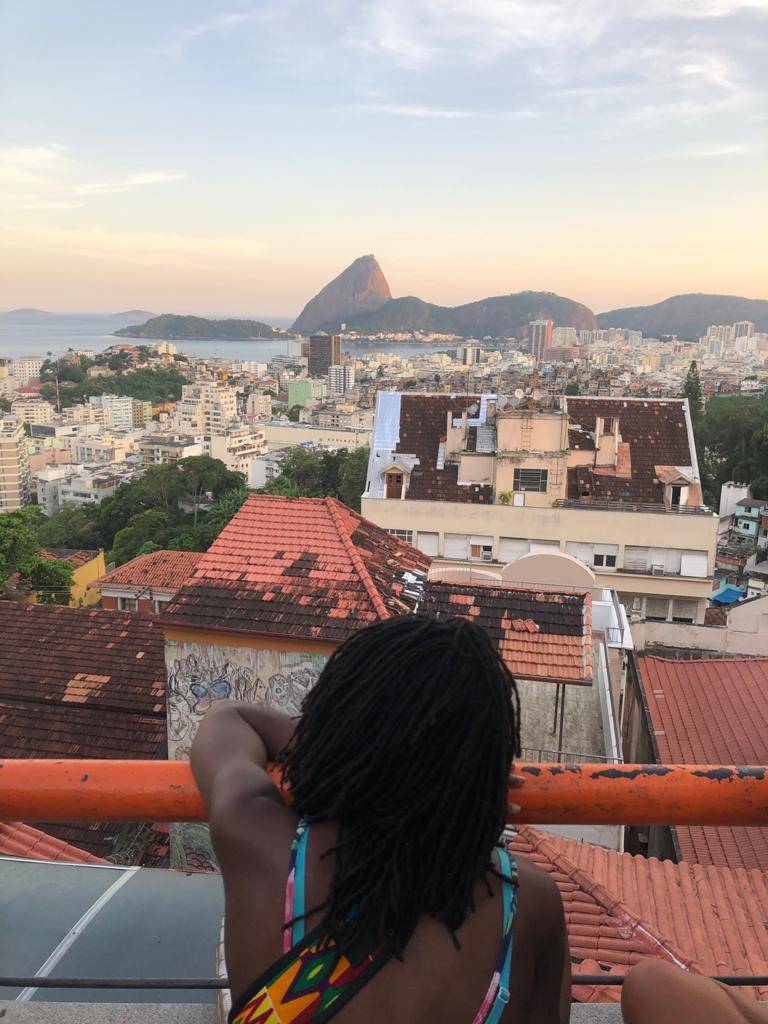
December 31st. Celebration day. The cariocas put on their white clothes. More than a million people are heading for the beaches of the South Zone. Some are holding flowers that they will throw into the sea to honour the goddess Yemanja, protector of fishermen and sailors, a syncretism of African rites and Christian traditions. From the morros (“hills”), one has the best view of the fireworks that will light up the sky at midnight. For one evening, everyone gets their share.
Izadora too has put on her bright clothes. She is supposed to meet Edilson and some other friends from Villa Kennedy in front of Posto 6, at the end of Copacabana beach. But the crowd is dense and her phone is not picking up any signal. She wanders around for a while looking for them. Then she hears a female voice calling her. She turns around: it’s Gabriela, one of her college friends. A blonde with laughing eyes. Rather funny for a girl from Sao Paulo. One of the only ones in the daytime group with whom she gets along well. She doesn’t know if it’s because of her Paulista (“from Sao Paulo”) accent that sounds like the one on TV, but when she speaks in class, she always feels like she’s saying something clever. When she heard her talk about her ambitions, Izadora thought: She wants to be a journalist. I just want to make it to the end of the year. She felt both jealous and admiring — of her voice, of her smooth hair… — to see her assert herself without any ambiguity.
It is with the same assurance that she takes her to a semi-private party on the beach. The space is delimited by barriers on which flags of foreign countries are hoisted. Entrances and exits are controlled by bracelets the guests wear around their wrists. Gabriela overdoes the familiarity with security to make sure that Izadora gets her prize. “I’m with my cousin Antonio and some friends of his from Sao Paulo, they’re really nice you’ll see!” At the bar, a dark haired boy with round cheeks and the same laughing eyes as Gabriela is waving at them. Next to him is a thinner boy with light eyes. He looks like the Chico Buarque who stayed forever young on her father’s bossa nova record sleeves. A Chico Buarque with curly hair.
She can’t tell what’s special about him, but she finds him something else… Something in his style. Or maybe the way he looks around him, the way he looks at her… Yeah, at her. Izadora doesn’t dislike that.
Other students join their group as they reach the bar and hug Antonio and his friend. When Izadora waits for the boy to speak a hesitant Portuguese, she understands that he is a foreigner. She doesn’t have time to ask herself about his origins, as Antonio gimmicks: “This is Matteo. He’s from Italy. From Rome. He has lived everywhere!” Matteo smiles with an air of someone who is used to being presented as the rare bird. Before Brazil, he’s already been to half a dozen countries on four continents. In São Paulo, the young man works in a language institute, but his dream is to make films. “He’s a bacana, isn’t he!” enthuses Gabriela. “Bacana maybe, but not so clever: what an idea to bury himself in Sao Paulo,” jokes Izadora, who acts like one you won’t impress so easily. The little Paulista congregation gently booed her between two bursts of laughter. At the entrance, a different kind of outburst emerges. “Why are you making trouble, I tell you I just want to talk to my friend and I’m leaving!” exclaims a familiar voice to Izadora. She turns around, the tone is rising between Edilson and security. All eyes are on them. Izadora rushes towards the entrance. Gabriela follows in her footsteps. She doesn’t hesitate to lie to security to calm the situation. “But of course they are with us! We lost sight of each other in the crowd, my battery was dead!” But it’s not enough to appease security, who wants to see Edilson’s ID and that of his two friends. “And why should I show it to you? Are you the police? Besides, this beach is public, isn’t it?” Security maintain their position. Edilson, with fire in his eyes and in his voice: “Come on Iza, let’s go, it’s not a place for us here.” She’s stunned, unable to act. In the meantime Antonio and Matteo have joined them. A friend of Edilson’s with a bitter voice: “Let it go irmao (‘brother’), let it go. She’s found new friends…” The other continues in the same tone: “Yes, we won’t bother ‘the student’.” Finally, Gabriela defuses the situation: “But we can go somewhere else, right, boys? We’ll buy some drinks and we’ll find a place on the beach to see the fireworks all together, ok?”
***
Half an hour later, once the presentations have been made and a few beers have been popped open, the atmosphere is relaxed in the newly formed group. Only Edilson seems to remain in his bad mood, which he openly manifests when Matteo and his improbable anecdotes from his first months in Brazil become the centre of the conversation:
“Ah yes, for the gringos, Brazil is always beautiful… The caipis, football, the beach, pretty girls… Come to Villa Kennedy, you’ll discover another country.”
Matteo argues that at a time when the United States and Europe are feeling the full impact of the financial crisis, Brazil has never experienced such an economic boom, rising from 13th to 7th place in the world, that the country is well placed to host the 2014 World Cup and the 2016 Olympic Games in its wake… And that millions of Brazilians have been lifted out of poverty under Lula’s government. Unprecedented.
Izadora likes to hear the bright-eyed Italian talk about this unknown country with the same name as hers. How beautiful is this Brazil dreamed of by Matteo, a country in which everything would prosper, with fertile soils and subsoils, where the illiterate worker could become president, where the original interbreeding of its people would protect it from racism, and its cordiality would protect it from the cruelty of men…
“This is the country of the future…” Edilson mocks.
Matteo, who did not perceive the irony of this phrase that has become proverbial in Brazil — that of a long promised future that never came to be — is enthusiastic:
“Exactly, the future is Brazil!”
And Gabriela, to set a lighter tone to the conversation, comments:
“I’d say that even in Brazil we’re already in the future… Look at this one!” she amuses herself, pointing at a street vendor with glittery cardboard glasses which look like the number 2020 on the tip of his nose. An idea that boosts his business: people are queuing up at his canteen both for the fruit Caipirinhas and to take a picture of the future.
And the small group starts dreaming aloud of what 2020 could look like: Gabriela would like to have become a journalist and have lived in Paris. Matteo would like to have made films and see them projected in an art house cinema in Rome where he used to go when he was a teenager. Edilson’s friends dream of a thriving business, of beautiful cars, of year-round tables in the posh nightclubs of Ipanema and Barra da Tijuca, of holidays in Florida, at Disney. Izadora points to the top floor of a building overlooking the beach, where she could see herself living:
“It would be a big apartment, a very big apartment… My mother and sister could come whenever they want. They would have their own room!”
Izadora sees a strange glow, something almost painful, passing through Edilson’s eyes. She doesn’t know how to interpret it.
“And you, Edilson, where do you see yourself in 2020?”
To this question, Edilson stands up without a word. Then after a few steps, he turns around and with a forced smile on his face says:
“I’m going to get cigarettes… I’ll be right back.”
None of his friends have enough time to point out they have cigarettes to share with him… Edilson has already disappeared in the compact crowd. Izadora looks for him, tries to find him with her eyes. To no avail.
2020 is a utopia. 2010, however, is finally shaping up with the sound and colours of fireworks. For a moment, a brief moment, the vision fogged by the foam of her beer and by these bronze, ivory and ebony bodies walking together towards the sea, her feet in this brown sugar sand, her face turned towards the sky with a thousand sparks, Izadora wants to believe that she was born in the most beautiful place on Earth. That the chaos will never prevail over beauty.
Her father’s saudades.
So when the countdown comes to an end and everyone hugs to wish each other the best for the year, better still, for the decade to come, she gives in to the urge for that kiss she’s had in mind since that moment when Matteo stared at her in that funny way. She gives in to his lips and his gaze, but she gives in even more to this crazy hope that the future Matteo talked about has brought about in her, a future that would only wait for her to be fulfilled.
***
In the morning, Izadora wakes up with a dreadful headache, her body aching as if she has been beaten up during the night. She buries her head in the pillow, a thousand images telescope in her head… The image of a dream, both foggy and strangely detailed, where surreal events and familiar faces intermingle. She has dreamt of huge demonstrations in Brazil, of the sound of pots and pans resounding from the windows of big cities, of a woman elected President deposed live on television, of the national team humiliated at home during the World Cup… Really, what an imagination! Izadora wonders where she got all that… With her eyes still closed, she pats her hand next to her bed. Strange, she doesn’t recognize the texture of the floor… She opens her eyes, has the confirmation of what she had sensed: the bed she slept in is not hers. The room she is in is unknown to her. The pretty lace she’s wearing too. But whose house did she sleep at? She walks to the window and steps on a device on the floor. She picks it up: it’s a telephone. Or rather a kind of iPhone. She’s already seen one in the window of one of those shops at Leblon Shopping where the latest technological gadgets sparkle like diamonds, but this model seems even flatter, more elegant…. She pushes a button at random, and the incomprehensible thing is that it’s her picture in the background. And this date… What does this date mean? March 16, 2020… What the fuck is this bullshit?! She exclaims. She feels her heart clenching in her chest, a whiff of panic beginning to mount. She rushes to the window and pulls the long double curtain whose noble manner slips through her fingers. It’s a huge bay window overlooking the beach of Copacabana… where she was celebrating the end of the decade 2000 only yesterday. And that reflection in the glass, who does it belong to? Who’s the straight-haired girl who borrowed her face?
There’s a knock on the door. Izadora jumps, hides her half-naked body behind the curtain. In the doorway, a familiar male voice:
“Amore, you’re awake…? Do you want me to make you a coffee before you go to work? I would have liked to go with you to the hospital… What happened to your sister is terrible… but this morning it’s complicated at the agency…”
“Matteo…?! What the hell are you doing here? And what am I doing here?”
Help us tell the world’s stories
By supporting Frictions, you sustain a community of writers and journalists who explore the world through intimate stories.
Their work is funded by our studio and by the members of our Club. Join them with a one-time or monthly donation.